Complete ecotouristic information database on national parks of Ecuador.
Ecuador is bordered by Colombia on the north, by Peru on the east and south, and by the Pacific Ocean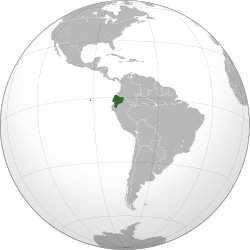 to the west. The country also includes the Galápagos Islands in the Pacific, about 965 kilometres west of the mainland. Ecuador has an area of 256,371 square kilometres. Its capital city is Quito, the country's largest city is Guayaquil.
Ecuador has three main geographic regions, plus an insular region in the Pacific Ocean:
- La Costa, or the coast, comprises the low-lying land in the western part of the country, including the Pacific coastline. The west coast is mainly dry, sovewhere it even turns into a semi-desert.
- La Sierra ("the highlands") is the high-altitude belt running north-south along the center of the country, its mountainous terrain dominated by the Andes mountain range.
- La Amazonía, also known as El Oriente ("the east"), comprises the Amazon rainforest areas in the eastern part of the country, accounting for just under half of the country's total surface area, though populated by less than 5% of the population.
- The Región Insular is the region comprising the Galápagos Islands.
Cotopaxi, which is just south of Quito, features one of the world's highest active volcanoes. The top of Mount Chimborazo (6,310-m above sea level) is considered to be the most distant point from the center of the earth, given the ovoidal shape of the planet (wider at the equator).
Ecuador is one of 18 megadiverse countries in the world. With 1,600 bird species (15% of the world's  known bird species) in the continental area, and 38 more endemic in the Galápagos. In addition to 25,000 species of plants, the country has 106 endemic reptiles, 138 endemic amphibians, and 6,000 species of butterfly. The Galápagos Islands are well known as a region of distinct fauna, famous as the place of birth of Darwin's Theory of Evolution, and a UNESCO World Heritage Site. Probably every nature lover has always dreamed about visiting this group of islands. This is a real paradise for those who want to take pictures of animals in calm even at close quarters.
As it was said before, all these ecosystems are cummulated on a comparatively small area which gives you a big advantage – you needn´t waste your time on long distance crossings and instead of this you can spend more time walking in nature. Moreover, Ecuador is a developed country with well-functionning infrastructure and travelling throughout the country is by no means problematic.