Complete ecotouristic information database on national parks of Europe.
Europe is, by convention, one of the world's seven continents. Comprising the westernmost peninsula of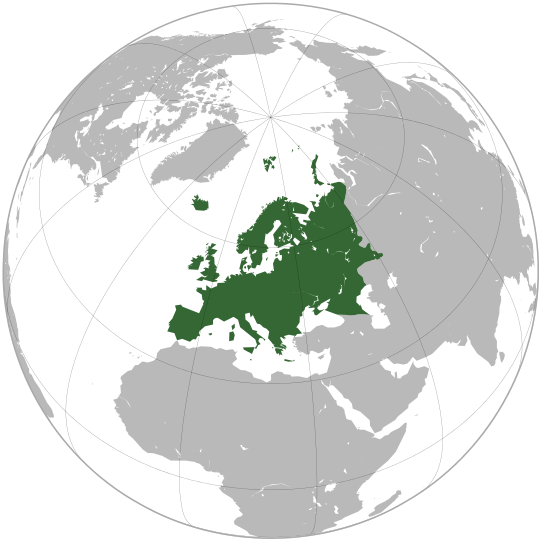 Eurasia, Europe is generally divided from Asia by the watershed divides of the Ural and Caucasus Mountains, the Ural River, the Caspian and Black Seas, and the waterways connecting the Black and Aegean Seas.
Europe is bordered by the Arctic Ocean to the north, the Atlantic Ocean to the west, the Mediterranean Sea to the south, and the Black Sea and connected waterways to the southeast.
Europe is the world's second-smallest continent by surface area, covering about 10,180,000 square kilometres or 2% of the Earth's surface and about 6.8% of its land area. Of Europe's approximately 50 countries, Russia is by far the largest by both area and population, taking up 40% of the continent, while Vatican City is the smallest. Europe is the third-most populous continent after Asia and Africa, with a population of 733-739 million or about 11% of the world's population.
Land relief in Europe shows great variation within relatively small areas. The average height above sea level is approx. 290 m (lowest from all continents) The southern regions are more mountainous, while moving north the terrain descends from the high Alps, Pyrenees, and Carpathians, through hilly uplands, into broad, low northern plains, which are vast in the east. This extended lowland is known as the Great European Plain. An arc of uplands also exists along the north-western seaboard, which begins in the western parts of the islands of Britain and Ireland, and then continues along the mountainous, fjord-cut spine of Norway. This description is simplified. Sub-regions such as the Iberian Peninsula and the Italian Peninsula contain their own complex features.
Europe lies mainly in the temperate climate zones, being subjected to prevailing westerlies. The climate ismilder in comparison to other areas of the same latitude around the globe due to the influence of the Gulf Stream. The Gulf Stream not only carries warm water to Europe's coast but also warms up the prevailing westerly winds that blow across the continent from the Atlantic Ocean.
Having lived side-by-side with agricultural peoples for millennia, Europe's animals and plants have been 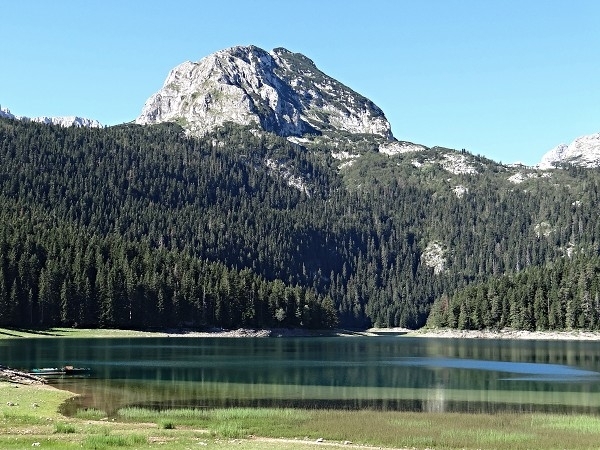 profoundly affected by the presence and activities of man. With the exception of Fennoscandia and northern Russia, few areas of untouched wilderness are currently found in Europe, except for various national parks.
The main natural vegetation cover in Europe is mixed forest. The conditions for growth are very favourable. In the north, the Gulf Stream warm the continent. Southern Europe could be described as having a warm, but mild climate. There are frequent summer droughts in this region. Mountain ridges also affect the conditions.
In temperate Europe, mixed forest with both broadleaf and coniferous trees dominate. The most important species in central and western Europe are beech and oak. In the north, the taiga is a mixed spruce–pine–birch forest; further north within Russia and extreme northern Scandinavia, the taiga gives way to tundra as the Arctic is approached. In the Mediterranean, many olive trees have been planted, which are very well adapted to its arid climate; Mediterranean Cypress is also widely planted in southern Europe. The semi-arid Mediterranean region hosts much scrub forest. A narrow east-west tongue of Eurasian grassland (the steppe) extends eastwards from Ukraine and southern Russia and ends in Hungary.
Original European ecosystems are protected in many national parks and nature reserves. Just those areas should be frequently visited as ecotouristic targets in Europe. Up to now, ecotourism in Europe is fast developing but still not as popular among people as it could be.
If you intend to recognize those regions full of nature beauties, use our database. Most of them are very easy to access.
Detailed information.
If you are willing to visit to national parks of some European country, you can continue further to separate countries national parks. Available is still database of Spanish national parks in Europe. Further countries information will come soon. If you have any question or request you can send it by attached Informative Form.