Complete ecotouristic information database on national parks of Spain.
Spain is located on the Iberian Peninsula in southwestern Europe. Its mainland is bordered to the south 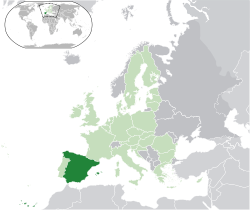 and east by the Mediterranean Sea except for a small land boundary with Gibraltar; to the north and north east by France, Andorra, and the Bay of Biscay; and to the west and northwest by Portugal and the Atlantic Ocean. It is one of three countries (Morocco, France) to have both Atlantic and Mediterranean coastlines. Spain's 1,214 km border with Portugal is the longest uninterrupted border within the European Union.
Spanish territory also includes the Balearic Islands in the Mediterranean, the Canary Islands in the Atlantic Ocean off the African coast, and two autonomous cities in North Africa, Ceuta and Melilla, that border Morocco. With an area of 505,992 km2, Spain is the second largest country in Western Europe and the European Union, the fifth largest country in Europe and 52th largest country of the world.
Mainland Spain is a mountainous country, dominated by high plateaus and mountain chains. After the Pyrenees, the main mountain ranges are the Cordillera Cantábrica, Sistema Ibérico, Sistema Central, Montes de Toledo, Sierra Morena and the Sistema Penibético whose highest peak, the 3,478 m high Mulhacén, located in Sierra Nevada, is the highest elevation in the Iberian peninsula. The highest point in Spain is the Teide, a 3,718-metre active volcano in the Canary Islands. The Meseta Central is a vast plateau in the heart of peninsular Spain.
There are several major rivers in Spain such as the Tajo, the Ebro, the Duero, the Guadiana and the Guadalquivir. Alluvial plains are found along the coast, the largest of which is that of the Guadalquivir in Andalusia.
Three main climatic zones can be separated, according to geographical situation and orographic conditions:
- The Mediterranean climate, characterized by dry and warm summers. It extends to additional areas not typically associated with a typical Mediterranean climate, with a climate more extreme, hot in summer and cold in winter, such as much of central and northern-central of Spain.
- The semiarid climate, located in the southeastern quarter of the country, especially in the region of Murcia and in the Ebro valley.
- The oceanic climate, located in north quarter of the country, especially in the region of Basque Country, Asturias, Cantabria and partly Galicia. Winter and summer temperatures are influenced by the ocean, and have no seasonal drought.
Apart from these main types, other sub-types can be found, like the alpine climate in the Pyrenees and Sierra Nevada, and a typical subtropical climate in the Canary Islands.
If you intend to recognize national parks of Spain, use our ecotouristic database.
Detailed information on Spanish National Parks.
Aigüestortes i Estany de Sant Maurici National Park, Archipiélago de Cabrera National Park
Cabaňeros National Park; Caldera de Taburiente National Park
Doňana National Park
Garajonay National Park
Islas Atlánticas de Galicia National Park
Monfragüe National Park
Ordesa y Monte Perdido National Park
Picos de Europa National Park
Sierra de Guadarrama National Park, Sierra de las Nieves National Park, Sierra Nevada National Park
Tablas de Daimiel National Park, Teide National Park, Timanfaya National Park
There is a database of this country national parks available.